A bioinspired membrane platform with a completed preclinical package and a clear regulatory path as a medical device.
Bioinspiration
Nature solved wet adhesion long before we did
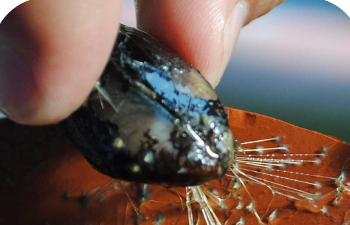
Mussels hold on to rocks battered by waves and salt water. Their secret is a family of adhesive proteins rich in catechols and amines, which stick to almost any surface, even underwater. We learned from them to build a material that sticks to living tissue.
From nature to the patient
Three steps from the sea to the clinic
01 · Nature
Mussel adhesive proteins
The mussel byssus uses L-DOPA, a catechol-rich amino acid, together with amines to create strong, flexible bonds on wet surfaces.
02 · Chemistry
A membrane made in one step
We combine catechols and amines in water, at room temperature, to grow a micron-thin membrane with a nano-structured surface.
03 · Biointerface
A patch that bonds to living tissue
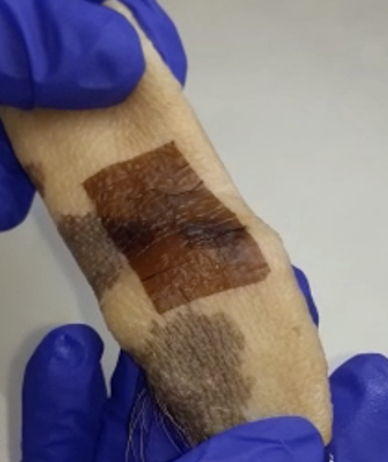
The result is a ready-to-use membrane that adheres to wet skin and tissue, protects it from infection and helps it regenerate.
How it works
One material, four functions
Mussels attach to wet surfaces thanks to proteins rich in catechol groups. We reproduce this chemistry in a thin, free-standing membrane made in a single step, in water and at room temperature.
The result is one material that does several jobs at once:
Adheres to wet tissue such as skin, cartilage or bone, with no sutures.
Fights infection through a sustained, contact-based release of reactive oxygen species, a physical mechanism that does not rely on antibiotics.
Supports regeneration as a nano-structured scaffold for cells and new blood vessels.
Degrades gradually during healing, so it never needs to be removed.
The material up close
Seeing is believing
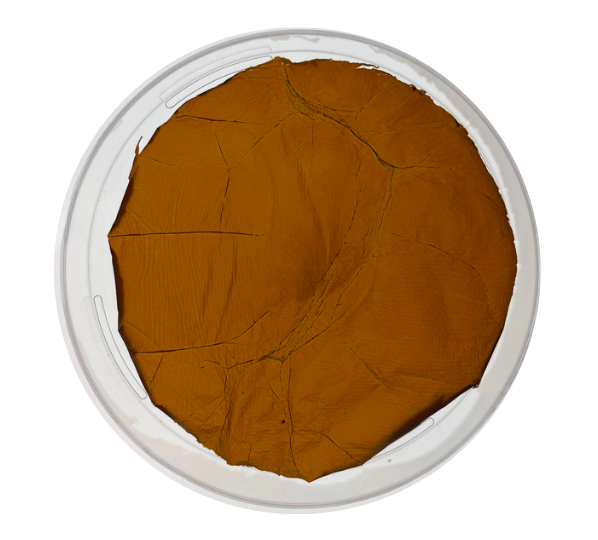
The RESKIN membrane, ready to use.
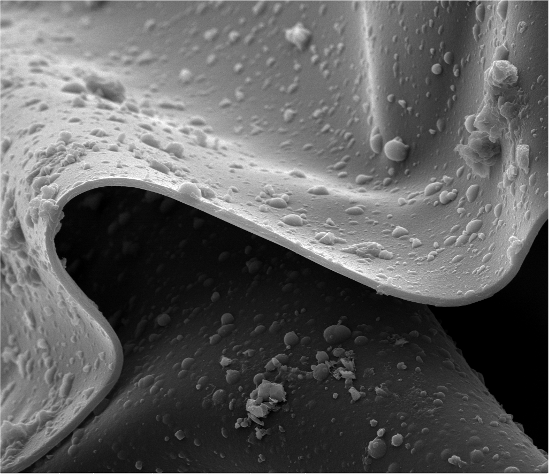
Electron microscopy: a thin, flexible film.
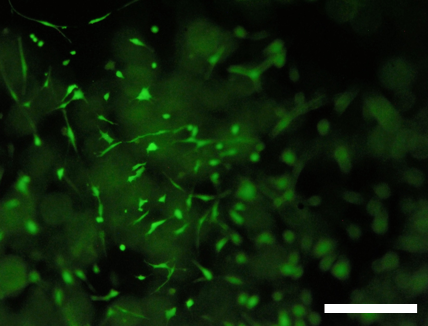
Skin cells (fibroblasts) anchored to the membrane.
Living cells growing on the material (fluorescence).
Evidence
Preclinical results in our lead indication: chronic wounds
Diabetic foot ulcer is the first clinical indication we have selected for RESKIN. The studies below were designed for chronic, infected wounds.
3% vs 58%
Infected wound model
Infection rate with RESKIN vs control in a porcine full-thickness infected wound model under GLP conditions (p<0.001).
13 vs 22 days
Faster healing
Time to complete wound closure (−41%), with new blood vessel formation and no chronic inflammation.
2 models
Diabetic wound model
A second porcine model of diabetic chronic wound, the closest model to diabetic foot ulcer, has been completed.
0
Antibiotics needed
Broad antimicrobial activity in vitro, including resistant bacteria, through a multi-pathway contact-killing mechanism.
Development stage
Road to the clinic
TRL 4–5
Done
Lab and relevant-environment validation
TRL 6
Reached 2026
Animal efficacy and safety, full ISO 10993, first external batch
TRL 7
2027
First-in-human feasibility study
TRL 8
2028–2030
Pivotal multicentre trial in Europe
TRL 9
Target
CE Mark and launch
Regulatory
After a consultation with the Spanish Agency of Medicines and Medical Devices (AEMPS) in 2025, RESKIN will be regulated as a medical device under the EU Medical Device Regulation. We are building the technical file and an ISO 13485 quality management system with specialised regulatory partners.
First-in-human study (2027)
An open-label feasibility study in patients with diabetic foot ulcers (Wagner 1–2). The main goal is safety and tolerability, with wound closure and infection as secondary endpoints and 12 weeks of follow-up, in reference hospitals in Spain.
Pipeline
One chemistry, many indications
Diabetic foot ulcer
Lead · advanced preclinical
Our first indication, with first-in-human planned for 2027.
Severe burns
Preclinical
A synthetic dermal substitute, validated in a burn model.
Venous and pressure ulcers
Preclinical
Extension to other hard-to-heal chronic wounds.
Veterinary wound care
Ready to license
Wounds in companion animals and horses, through licensing partners.
Cartilage and osteoarthritis
Preclinical
Cartilage repair, with clinical and academic partners.
Glioblastoma
Preclinical
Co-development with a neuro-oncology research group.
Medical wearables
Exploratory
Sensors integrated in the membrane, with industry partners.
Nerve regeneration
Early research
New conductive membranes as soft, adhesive bioelectrodes.
Intellectual property
Protected and free to operate
International patent application WO2022258780A1 (priority 2021), owned by ICN2 and CSIC and licensed exclusively worldwide to Tirecat Health, with national phases in Europe, the USA, Canada, Australia, New Zealand, Israel, Korea and Japan. New patent applications have been filed on infection and on conductive membranes for nerve regeneration. A freedom-to-operate analysis found no blocking patents.
RESKIN is an investigational medical device. It is not available for sale. Results described on this page come from preclinical studies.